
For most of the last century, the air inside our schools, libraries, and public buildings was something we simply trusted. If a room was warm in winter and cool in summer, the building was doing its job. Nobody measured what people were actually breathing, because there was no easy way to do it.
That has changed completely. Affordable, accurate indoor air quality sensors now make it possible to see, in real time, exactly what is in the air of any occupied space. And as that visibility has arrived, so has a new expectation: that the organizations responsible for public buildings will manage indoor air the way they manage any other critical system. For facilities managers, school district leaders, and building operators, indoor air quality monitoring has moved from a nice idea to a core responsibility.
This guide walks through what indoor air quality monitoring measures, why schools and public buildings are the highest priority, how monitoring connects to compliance and IAQ management plans, and how to build a program that scales.
What Indoor Air Quality Monitoring Actually Measures
Indoor air quality monitoring is the practice of continuously tracking the pollutants and conditions that affect health, comfort, and cognition inside a building. Modern air monitoring systems do this automatically, around the clock, and feed the readings into a dashboard that turns raw numbers into something a manager can act on.
The core parameters worth tracking are consistent across building types. Carbon dioxide is the single most useful reading, because it functions as a reliable proxy for whether a space is being ventilated adequately for the number of people in it. Fine particulate matter, or PM2.5, captures the small particles that penetrate deep into the lungs. Volatile organic compounds reveal off-gassing from furniture, flooring, and cleaning products. Humidity and temperature round out the picture, since both influence comfort, pathogen survival, and the growth of mold.
An indoor air quality sensor like the AirGradient ONE tracks all of these at once. For understanding what a building pulls in from outside, an outdoor unit like the AirGradient OPEN AIR adds essential context, and a portable monitor like the AirGradient GO lets a facilities team spot-check specific rooms without installing permanent hardware everywhere at once.
Why Schools Are Ground Zero for Air Quality Monitoring
No building type has more at stake than a school. Children breathe more air relative to their body size than adults, their lungs are still developing, and they spend thousands of hours inside classrooms during their most formative years. When classroom air quality suffers, the consequences show up as lost focus, more sick days, and measurable declines in performance.
The carbon dioxide problem is especially acute in classrooms. A full classroom with the windows closed and an aging HVAC system can push CO2 well past the point where cognition starts to slip, often without anyone noticing. This is why classroom air monitoring has become a priority for so many districts, and why school air sensors are increasingly seen as basic educational infrastructure rather than an optional upgrade. We explored the direct link between school indoor air quality and student outcomes in our look at indoor air quality in schools.
For a school district, the value of air quality sensors compounds across buildings. Deploying K-12 air quality monitoring across a district gives administrators a single, comparable view of every campus, revealing which buildings and which specific rooms need attention first.
That district-wide visibility is exactly what turns scattered complaints into a defensible, data-driven facilities plan. And the same logic extends to the youngest learners, where early childcare settings carry their own heightened stakes, as we described in why childcare centers become germ hotspots.
Beyond the Classroom: Libraries, Offices, and Government Buildings
Schools are the clearest case, but they are far from the only one. Any building where people gather for hours at a time benefits from building air quality monitoring. Libraries, with their quiet, densely occupied reading rooms, are a natural fit for library air quality monitoring.
Municipal offices, courthouses, and other government buildings carry a public-health responsibility to the citizens and staff who use them, which makes government building air quality a growing area of focus. Commercial offices, healthcare clinics, and senior living communities each have their own reasons to care, as we covered for vulnerable populations in senior living and healthcare settings.
For the facilities managers responsible for these spaces, the appeal of commercial air quality sensors is practical. Instead of reacting to comfort complaints one at a time, a manager with continuous data can see problems developing and address them proactively. Air quality monitoring for facilities managers is really about the same thing every other building system provides: visibility, early warning, and the ability to prove that the building is performing as intended.
From Data to Compliance: IAQ, IEQ, and the ASHRAE Standards
Monitoring is not only about health and comfort. It is increasingly about compliance, and this is where the standards come in.
The foundational document is ASHRAE Standard 62.1, which sets minimum ventilation rates for acceptable indoor air quality in commercial and institutional buildings based on occupancy and floor area. Many older buildings were designed under earlier versions of this standard, or have drifted out of compliance as equipment ages and occupancy patterns change. Continuous carbon dioxide monitoring is one of the most reliable ways to check whether a building is actually delivering the fresh air its design promises, rather than just meeting specifications on paper.
More recently, ASHRAE published Standard 241, Control of Infectious Aerosols, approved in 2023. It was developed rapidly at the request of federal officials as a national standard for reducing airborne disease transmission, and it applies across schools, healthcare, commercial, and public buildings. Its central concept is “equivalent clean airflow,” the amount of pathogen-free air a space needs, which can be delivered through any combination of ventilation, filtration, and air cleaning. Standard 241 also calls for a building readiness plan and an infection risk management mode that a facility can activate during periods of elevated public health risk.
Importantly, monitoring is what verifies that these airflow targets are being met, which makes air quality data the foundation of any credible compliance effort.It helps to think in terms of indoor environmental quality, or IEQ, the broader concept that folds air quality together with the other conditions that shape how a space feels and functions. Healthy buildings are ones where all of these factors are measured and managed rather than assumed.
Building an IAQ Management Plan
The bridge between raw sensor data and lasting results is an indoor air quality management plan. A good plan does not require a full building renovation. It requires a repeatable process, and continuous monitoring is what makes that process possible.
Start by measuring. Deploy sensors across classrooms, common areas, and problem spaces to establish a baseline before changing anything. Next, identify the worst-performing spaces, because the data almost always shows that some rooms are far worse than others. Then address ventilation and filtration in sequence, improving fresh air delivery where you can and adding air cleaning where ventilation alone falls short. Monitor continuously and iterate, because seasons, occupancy, and building changes all shift conditions over time.
Finally, communicate the results to the community, since parents, staff, and the public all have a stake in the environment and respond to transparency. This framework scales naturally. School IAQ management plans, early childcare IAQ management plans, and public building plans all follow the same measure-first logic, adapted to the occupants and risks of each setting. We laid out this approach in more depth in Smart Air Quality Solutions for Modern Facilities.
Where Air Purification Fits
Monitoring tells you what is wrong. Air purification solutions are often part of what fixes it. When ventilation cannot deliver enough clean air on its own, air purifiers that combine HEPA-grade filtration with UV-C disinfection can close the gap, capturing particles and inactivating airborne pathogens at the same time. The INVZBL air purification systems are built for exactly this role, in both fixed and portable configurations, so protection can be added where the data shows it is needed most.
This pairing matters for compliance as well. ASHRAE Standard 241 treats filtration and air cleaning as legitimate ways to reach the required equivalent clean airflow, provided the equipment meets its performance and safety requirements. In practice, that means a well-designed combination of monitoring and purification is not just good for occupants. It is a documented path toward meeting the standard.
Scaling From One Building to an Entire Portfolio
A single monitor in a single classroom is useful. A connected system across an entire district or building portfolio is transformational. Enterprise air quality monitoring brings every space into one dashboard, so a facilities director or superintendent can compare buildings, spot trends, and prioritize investment with confidence. For organizations managing many sites, nationwide air quality monitoring solutions make it possible to hold every location to the same standard and report on all of them from one place.
That centralized visibility is what elevates air quality from a maintenance afterthought to a strategic asset. It supports budgeting, demonstrates accountability to the public, and builds the kind of trust that unlocks continued investment in healthier buildings.
Our Online Store Is Now Open
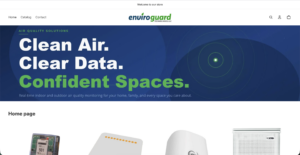
Getting started has never been simpler. We are excited to announce that the EnviroGuard Technologies online store is officially open, so you can now browse and buy the monitoring and purification equipment described throughout this guide directly.
The store carries the full lineup, including the AirGradient ONE indoor air quality sensor, the AirGradient OPEN AIR outdoor monitor, the portable AirGradient GO, and the AirGradient Dashboard that ties every reading together in one place. On the purification side, you will find the portable INVZBL Air Base One and the ceiling-mounted INVZBL N-AIR. You can view everything at once in the full catalog.
Whether you are outfitting a single classroom or planning a district-wide rollout, the store makes it easy to take the first step toward a healthier building today.
Getting Started
The first step is always measurement, because without a baseline every decision about improvement is a guess. EnviroGuard Technologies provides indoor air quality monitoring and purification solutions scaled for a single classroom, an entire campus, or a full portfolio of public buildings, along with the dashboard and reporting tools that turn continuous data into confident facility decisions.
If you are responsible for the air in a school, library, or public building and want to know what it is really delivering, shop our online store or reach out to our team and we will help you build a monitoring and management program that fits your buildings and your budget.
EnviroGuard Technologies provides easy-to-use air quality monitors and purifiers for homes, schools, childcare centers, senior living, healthcare, and businesses. Learn more at enviroguardtech.com.